Architecture
wsistream uses a pipeline of pluggable components. Each component is defined by an abstract base class with a single method to implement.
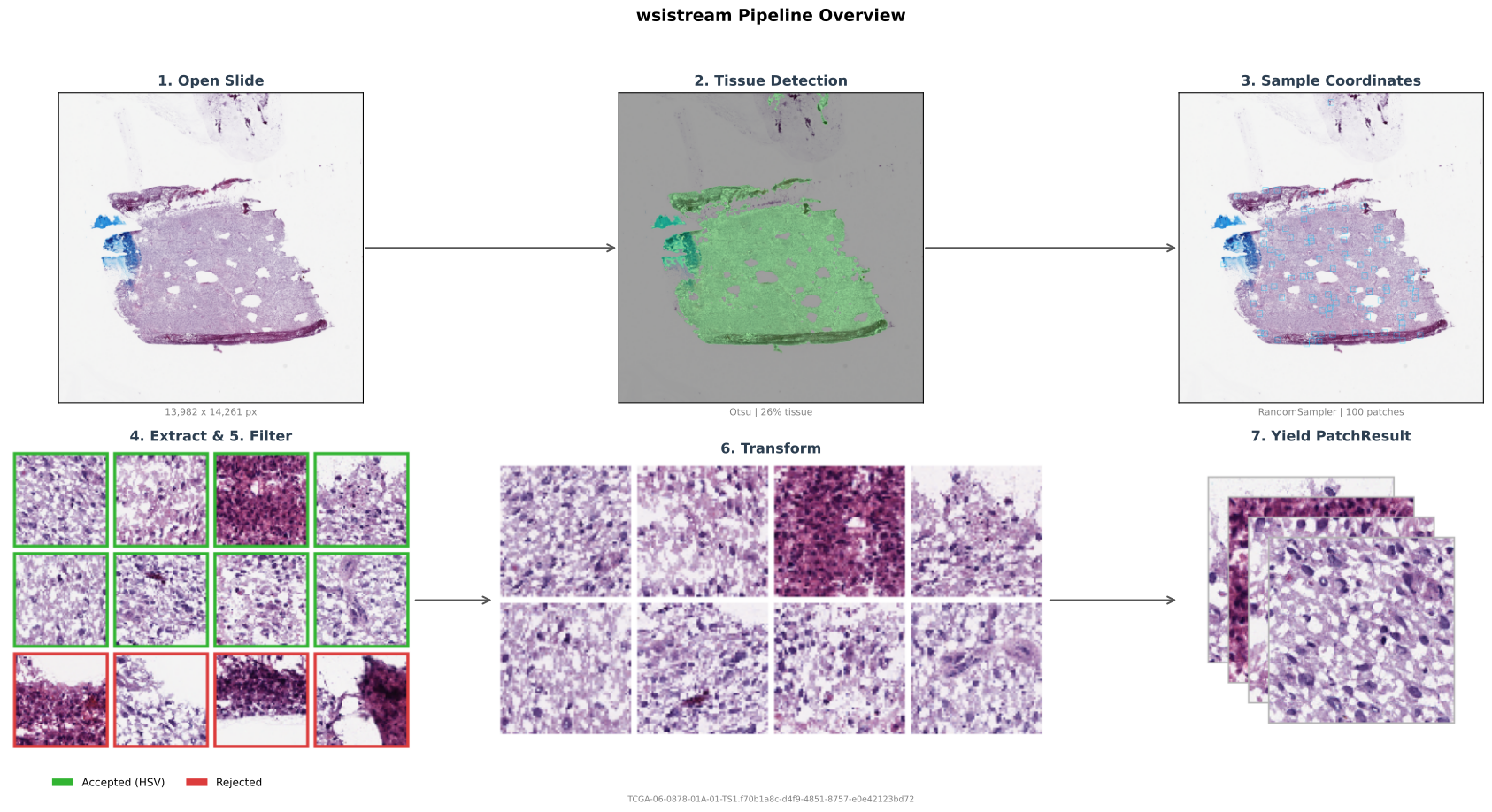
The pipeline flow
For each slide, the pipeline executes the following steps:
- Open the slide via
SlideHandlewith the configured backend - Thumbnail: generate a low-resolution overview of the slide unless a compatible tissue mask is cached
- Tissue detection: run the
TissueDetectoron the thumbnail to produce a binaryTissueMask, unless that mask was cached - Sampling: pass the slide and mask to the
PatchSampler, which yieldsPatchCoordinates - Extraction: read each patch from the slide at the specified pyramid level
- Filtering: run the
PatchFilteron the extracted patch -- accept or reject - Transform or views: apply the
PatchTransformchain, or produce multiple named views - Yield: produce a
PatchResultcontaining the image, coordinates, tissue fraction, and metadata
Steps 3 and 6 are both tissue/quality checks, but at different resolutions:
- TissueDetector (step 3): coarse, runs once per slide opening on a low-resolution thumbnail, or once per cached slide while its mask remains in the cache.
- PatchFilter (step 6): fine-grained, runs on every extracted patch. Sees actual pixel content at the sampled resolution. This is where Midnight's per-tile HSV check belongs (Karasikov et al., 2025).
Pool-based slide interleaving
The PatchPipeline maintains a pool of simultaneously open slides (controlled by pool_size) and round-robins across them, ensuring patches from different slides are interleaved in the output stream. By default, one patch is read per slide before advancing (patches_per_visit=1); set higher for better I/O locality on network filesystems.
Each slide has a patches_per_slide budget. Once a slide exhausts its budget, it is closed and replaced by the next slide from the queue. This prevents any single slide from dominating the stream.
When cycle=True, the slide queue is refilled after all slides have been processed, producing an infinite stream that cycles over the entire corpus. This is the intended mode for FM training.
graph LR
    subgraph Pool1["Pool 1"]
        direction LR
        r1["A B C D"] --> r2["A B C D"] --> r3["A B C D"]
    end
    subgraph Pool2["Pool 2"]
        direction LR
        r4["E F G H"] --> r5["E F G H"] --> r6["E F G H"]
    end
    r3 -->|"close & open"| r4
Example with pool_size=4 and patches_per_slide=3: each box is one round-robin pass yielding one patch per slide. After 3 patches from each slide, the pool rotates.
I/O locality with patches_per_visit
By default, the pipeline reads one patch per slide before advancing to the next (patches_per_visit=1). On network filesystems (NFS, Lustre, GPFS), this causes frequent cache misses because every read hits a different file. Setting patches_per_visit to a higher value (e.g., 8-16) reads multiple consecutive patches from the same slide before round-robining, keeping the OS file cache warm:
pipeline = PatchPipeline(
    ...,
    pool_size=20,
    patches_per_slide=500,
    patches_per_visit=10,  # read 10 patches before advancing to next slide
)
This trades some interleaving granularity for significantly better I/O throughput. The total number of patches per slide is unchanged — only the order within the pool changes.
Tissue-mask caching
With cycle=True, a slide may be reopened many times and tissue detection normally runs again for every opening. Set tissue_mask_cache_size to a positive number to retain that many successful masks in a least-recently-used cache:
Caching is disabled by default (tissue_mask_cache_size=0) because reusing a mask changes the behavior of stateful or stochastic tissue detectors and consumes memory. A boolean mask at the default thumbnail_size=(2048, 2048) occupies approximately 4 MiB, so 64 entries require approximately 256 MiB, excluding small object overhead. The cache belongs to one PatchPipeline instance in one process; with WsiStreamDataset, each DataLoader worker and each new dataset iteration creates its own cache, so multiply the configured capacity by the number of active workers when estimating peak memory.
Cache entries are invalidated automatically when the backend object, tissue-detector object, or thumbnail_size is replaced. If a detector or backend is mutated in place, a slide file is replaced while the pipeline is alive, or any other input to mask generation changes without replacing those objects, call pipeline.clear_tissue_mask_cache() before continuing; for WsiStreamDataset, close the active iterator and create a new one. Only successful detections are cached, cached arrays are isolated from sampler mutations, and cache contents are not serialized into worker processes.
Data types
The pipeline produces PatchResult objects. Here are the key data types:
PatchResult -- one extracted patch with all its context:
| Field | Type | Description |
|---|---|---|
image |
np.ndarray or None |
Patch pixels when transforms are used. (H, W, 3), uint8 (or float32 after normalization). |
views |
dict[str, np.ndarray] or None |
Named multi-view outputs when views are configured. |
coordinate |
PatchCoordinate |
Where this patch came from. |
tissue_fraction |
float |
Fraction of the patch region covered by tissue, in [0, 1]. |
slide_metadata |
SlideMetadata or None |
Dataset-specific metadata (when a DatasetAdapter is configured). |
PatchCoordinate -- location of a patch within a slide:
| Field | Type | Description |
|---|---|---|
x, y |
int |
Top-left corner in level-0 pixel coordinates. |
level |
int |
Pyramid level the patch was read from. |
patch_size |
int |
Width and height of the patch at the target level. |
mpp |
float or None |
Effective microns per pixel of the patch. |
slide_path |
str |
Path to the source slide. |
SlideMetadata -- dataset-specific information (populated by a DatasetAdapter):
| Field | Type | Description |
|---|---|---|
slide_path |
str |
Path to the slide. |
dataset_name |
str |
Name of the dataset (default "unknown"). |
patient_id |
str or None |
Patient identifier. |
tissue_type |
str or None |
Tissue type. |
cancer_type |
str or None |
Cancer type (e.g., TCGA-BRCA). |
sample_type |
str or None |
Sample type (e.g., Primary Solid Tumor). |
extra |
dict |
Additional fields specific to the dataset. |
Built-in components
| Component | Implementations |
|---|---|
| Backends | OpenSlideBackend (C-based), TiffSlideBackend (pure Python, cloud-compatible via fsspec) |
| Tissue Detectors | OtsuTissueDetector, HSVTissueDetector, CLAMTissueDetector, CombinedTissueDetector (logical AND of multiple detectors) |
| Samplers | RandomSampler (rejection sampling, supports target_mpp), GridSampler (exhaustive grid, configurable stride), MultiMagnificationSampler (samples across multiple pyramid levels), ContinuousMagnificationSampler (crop-and-resize at continuously varying magnification) |
| Filters | HSVPatchFilter (per-tile HSV pixel check, Midnight-style) |
| Transforms | HEDColorAugmentation, RandomFlipRotate, ResizeTransform, NormalizeTransform, AlbumentationsWrapper, ComposeTransforms |
| Views | ViewConfig, RandomResizedCrop for multi-view and multi-crop outputs |
| Dataset Adapters | TCGAAdapter (parses TCGA barcodes for patient ID, cancer type, sample type) |
Configuration
PatchPipeline(
    slide_paths="/data/tcga",   # directory or list of file paths
    backend=OpenSlideBackend(), # how to read slides
    tissue_detector=...,        # what is tissue vs. background (on thumbnail)
    sampler=...,                # where to extract patches
    patch_filter=...,           # accept/reject extracted patches (on actual pixels)
    transforms=...,             # augment accepted patches
    views=...,                  # optional multi-view outputs (mutually exclusive with transforms)
    shared_transforms=...,      # optional transform applied once before per-view processing
    dataset_adapter=...,        # attach dataset-specific metadata (e.g., TCGA)
    thumbnail_size=(2048, 2048),# resolution for tissue detection
    tissue_mask_cache_size=0,   # bounded LRU cache; 0 disables caching
    pool_size=8,                # slides open simultaneously
    patches_per_slide=100,      # per-slide budget before rotation
    patches_per_visit=1,        # patches per slide before round-robin (increase for I/O locality)
    slide_sampling="sequential",# "sequential" or "random" slide order
    cycle=False,                # infinite cycling over slides
    replacement="with_replacement",  # "without_replacement" for no repeated coords per slide
    seed=None,                  # random seed for slide-level shuffling
)
Adding new components
Every component follows the same pattern: subclass the base, implement one method.
from wsistream.tissue.base import TissueDetector

class MyDetector(TissueDetector):
    def detect(self, thumbnail, downsample=(1.0, 1.0)):
        return ...  # boolean mask


from wsistream.sampling.base import PatchSampler

class MySampler(PatchSampler):
    def sample(self, slide, tissue_mask):
        yield ...  # PatchCoordinate


from wsistream.filters.base import PatchFilter

class MyFilter(PatchFilter):
    def accept(self, patch):
        return ...  # True to keep, False to discard


from wsistream.transforms.base import PatchTransform

class MyTransform(PatchTransform):
    def __call__(self, image):
        return ...  # transformed image


from wsistream.datasets.base import DatasetAdapter

class MyAdapter(DatasetAdapter):
    def parse_metadata(self, slide_path):
        return ...  # SlideMetadata